
Chapter 1: The Real Cost of Moving USDT on TRON
TRON settles more stablecoin volume than any other network on earth — but every one of those transfers still carries a toll most holders never budgeted for. Sending USDT isn't free: the network burns TRX to cover the computational "Energy" behind it. A standard transfer costs roughly 6.4 TRX; send to a brand-new or empty wallet and that jumps to roughly 13.4 TRX, since the network has to allocate the account itself. For anyone moving stablecoins often — a merchant, a payroll desk, an active trader — that's a real, compounding capital drain, paid in a token that has nothing to do with the payment actually being made.
The market's answer has been Energy Delegation: third-party rental platforms that let users lease Energy on demand instead of burning TRX outright, cutting the effective cost by roughly 60–80% — down to an estimated 3–6 TRX per transfer under typical conditions. That floor moves, too: under heavy network weight, or when sending to a new or empty wallet, the effective cost climbs well past that range. And Energy isn't the only resource being spent — Bandwidth is a separate TRON resource that every transaction consumes, and it burns TRX of its own whenever a wallet hasn't banked enough of it, on top of whatever's already being paid for Energy. For high-frequency users, renting Energy has gone from a clever optimization to something close to a requirement.
It's a real improvement. It's also not the fix it looks like — it just moves the friction somewhere less visible.
Chapter 2: The Maintenance Trap — Why "Cheaper" Still Means "More Work"
Energy delegation lowers the bill, but it hands the user a second job: keeping the lease alive. That job breaks down into three ongoing tasks nobody signed up for.
Balance top-ups — you still need a base layer of TRX on hand just to pay the rental platform for the lease itself. Duration management — Energy is typically rented in hourly or daily blocks, and if the lease lapses before you send, you're quietly dropped back to burning full-price TRX. Predictive friction — you have to forecast the right amount to rent (roughly 65,000 units for a standard transfer, closer to 131,000 for a brand-new wallet, as a rough baseline), and that target itself isn't fixed: required Energy shifts with network conditions — congestion, contract complexity, and the network's overall Energy weighting all move it — so the forecast you made yesterday isn't guaranteed to hold today.
None of this solves the underlying problem — it relocates it. Instead of one token to think about, the user now maintains two: the stablecoin they actually want to move, and a TRX/Energy position that exists purely to keep the first one movable. And because those two things can run out independently, the lease can expire quietly, at the worst possible moment.
Chapter 3: The Zero (or Insufficient) Balance Dead End
That worst moment has a name: the zero-balance dead end — though "zero" undersells it, since a TRX balance that's simply too low to cover the required fee leads to the exact same wall. Even a user who's mastered energy rental eventually lands here, because a wallet holding no TRX, or not quite enough of it, is a wallet that's completely stuck — not through carelessness, but through the ordinary shape of how people actually receive stablecoins.
It happens because someone only ever receives USDT as payment and never separately buys TRX. It happens when a lease expires and the last of a wallet's TRX gets quietly burned on one unoptimized send. It happens when the Energy required to reach a new address is simply miscalculated.
Whatever the cause, the outcome is identical: a wallet that can't send USDT and can't even lease more Energy to fix itself, because leasing also costs TRX. The only way out is the one the whole system was supposed to make unnecessary — abandon the wallet, go to a centralized exchange, buy a minimum TRX amount, pay a withdrawal fee, and bridge it back. That detour is exactly where retention dies.
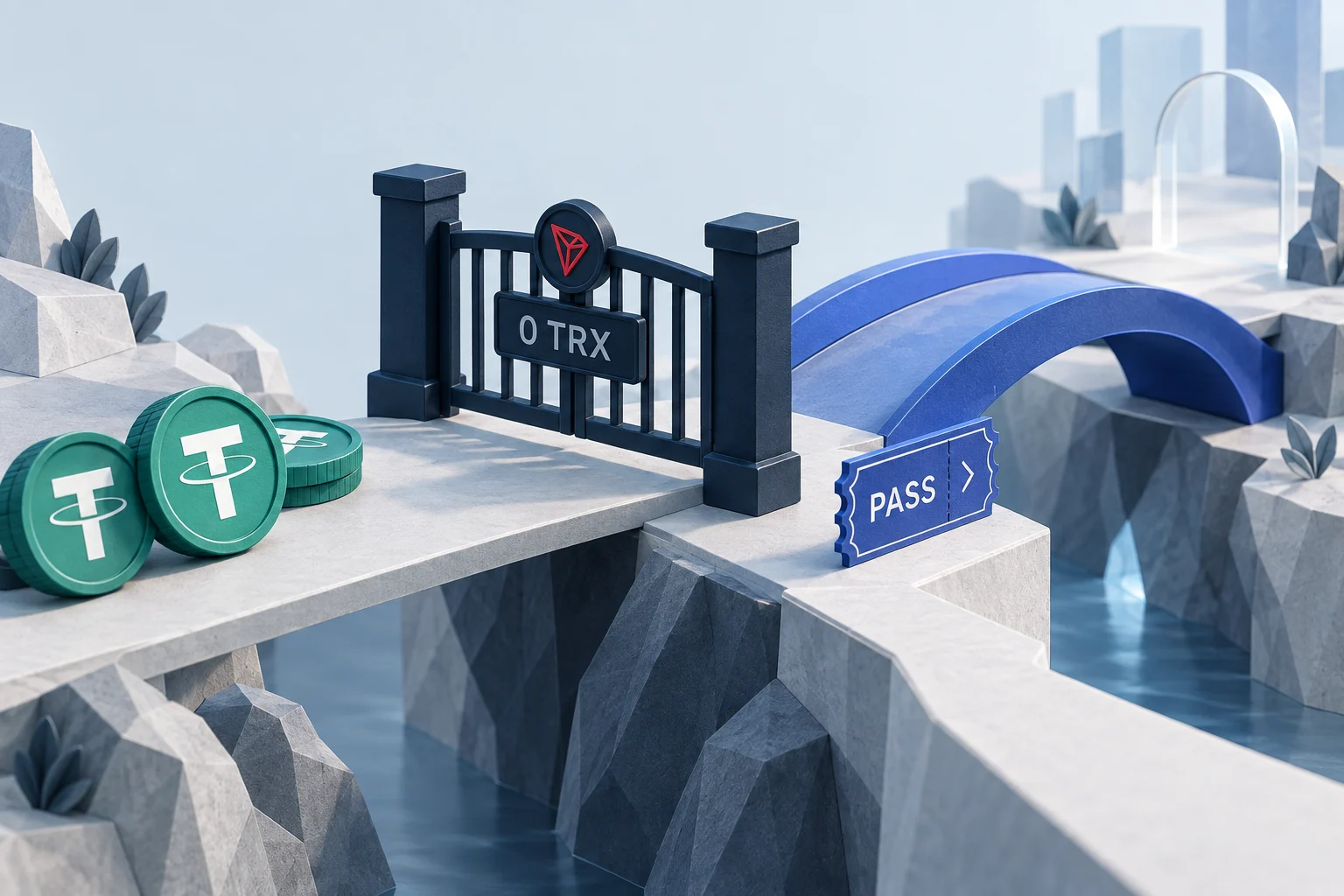
USDT available, but not enough TRX? →Chapter 4: Removing the Tradeoff Entirely
The pattern across all three chapters is the same: TRON asks every stablecoin holder to also become a part-time resource manager — tracking Energy decay, timing rentals, forecasting volume — just to send money they already have. That's not a user-education gap. It's a wallet-design gap, and it's the one Coinductor was built to close.
Smart Send handles Chapters 1 and 2 automatically: on every transfer, it checks the live cost of renting Energy against paying in TRX and takes whichever is cheaper, in real time, with nothing to configure and no rental dashboard to babysit — typically landing 70% below a standard on-chain transfer. There's no lease to expire, because there's no lease for the user to manage in the first place.
Send with Smart Send →OTO Pass is the direct answer to Chapter 3's dead end — and it isn't limited to the Energy side of that equation. Both the Energy and Bandwidth cost behind a transfer are replaced by a single one-time in-app purchase — via Apple Pay or Google Pay — so a wallet with zero TRX, or simply not enough of it to cover either resource, can still send. No exchange, no minimum top-up, no withdrawal fee, no bridge back. The recipient gets the full amount; the sender never has to leave the app to fix a problem the network created.
And critically, none of this comes at the cost of self-custody. Coinductor automates fee routing, not custody — recovery phrases are generated on-device, encrypted at rest, and never touch Coinductor's servers, and every transfer still requires the wallet owner's own signature. Paying a network fee through Apple Pay or Google Pay changes how the fee gets paid; it changes nothing about who holds the keys.
The gas token problem was never something users needed to get better at managing. It's something the wallet should have solved from the start — so that holding a stablecoin is the only requirement for sending one.