
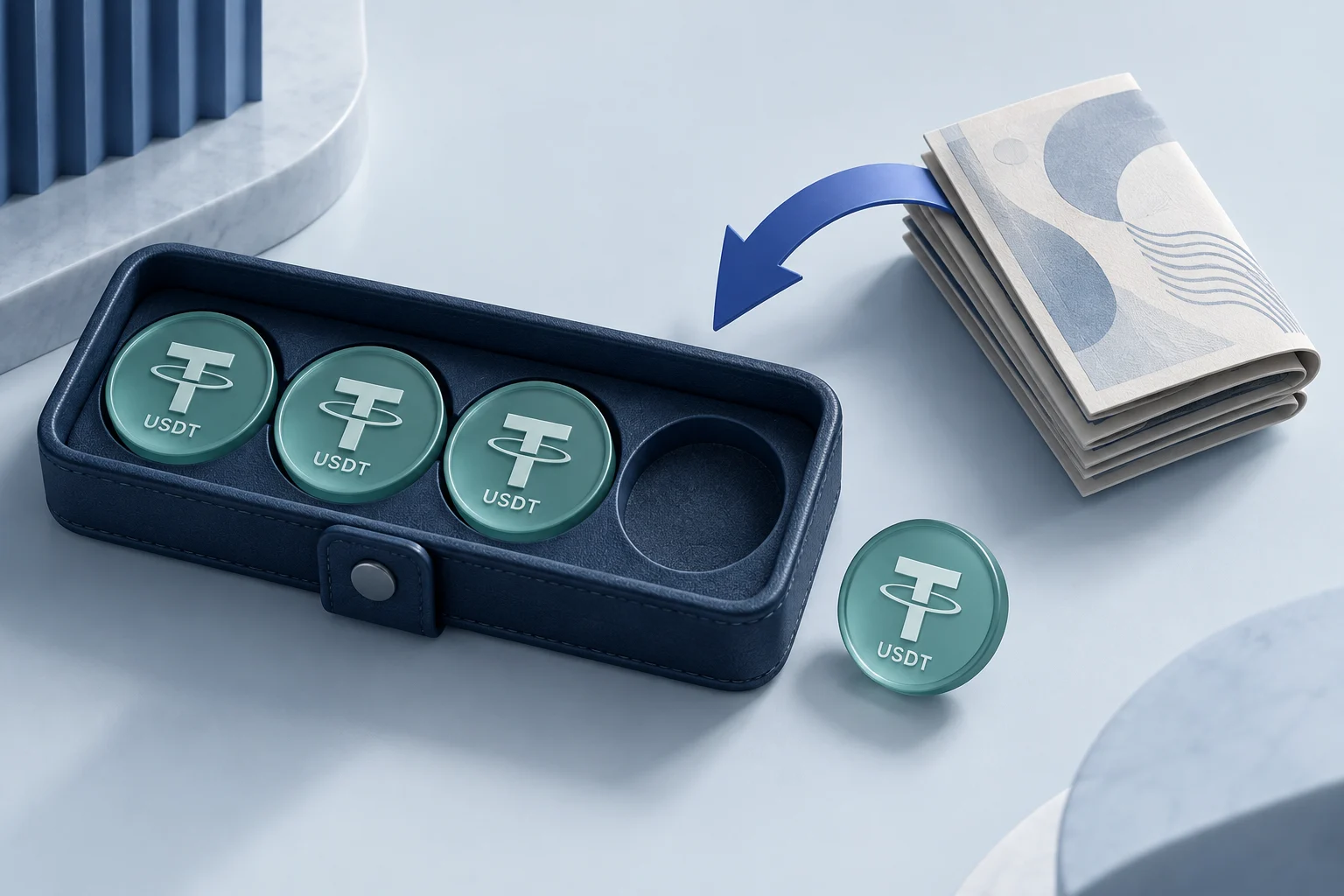
You hold USDT for a reason. Perhaps it is money set aside for a future purchase, a payment you need to make, or a balance you have built up over time. When part of it goes toward a transfer fee, that part is no longer available for those purposes.
Once spent on a fee, those USDT have zero remaining purchasing power for you. The same is true of local currency spent on a fee. The useful distinction is which balance you want to preserve—and what it would cost to replenish it.
The fee provides a transfer service. Paying in USDT can be convenient, particularly when it avoids acquiring a separate network token. Paying separately can suit someone who wants to retain their USDT for future spending. Neither preference, on its own, establishes which option is cheaper.
A small fee changes what remains
Imagine you have 100 USDT and want someone to receive 20 USDT. In this hypothetical example, the transfer service charges an additional 2 USDT.
Fee paid from USDT
100 USDT − 20 USDT sent − 2 USDT fee
The recipient receives 20 USDT.
Transfer cost paid separately
100 USDT − 20 USDT sent
The recipient receives 20 USDT. You also pay a separate transfer-access charge.
Illustrative amounts, not a Coinductor price quote or a comparison of total costs. Actual fees and eligibility vary.
The difference is 2 USDT still available for a later purchase or payment. Paying for the transfer separately does not make it free: money leaves another balance instead. It changes which balance pays for the transfer.
Replacing USDT can cost more than the reference rate suggests
For someone who acquired USDT at a premium in local currency, spending it on fees has another consequence: replacing it may require paying that premium again. What matters for the next decision is the current, accessible replacement price—not just the historical price paid.
Consider a second hypothetical example. The reference exchange rate is 100 local-currency units per US dollar, but the accessible purchase price is 110 local-currency units per USDT. Replacing 2 USDT would cost 220 local-currency units at that purchase price, before any additional charges.
For that holder, simply describing the fee as “about two dollars” misses part of the practical decision. The relevant question is: what would it cost me to restore those 2 USDT?
At that same replacement price, a separately paid charge of 200 local-currency units would cost less than replacing the 2 USDT. A charge of 240 would cost more. Both would preserve the USDT balance, but only the first would be cheaper in this simplified comparison. These are hypothetical amounts and assume no other charges.
Purchase prices and exchange rates change. A premium is not universal, and preserving USDT does not automatically make a separately paid option cheaper. The original acquisition cost and the replacement cost should not be added together as though both were new costs of this transfer.
The payment currency matters alongside the price
Two users can look at the same fee and prefer different ways to pay it. One may value the convenience of paying from an existing USDT balance. Another may prefer to spend local money and leave their USDT allocation intact.
“How much does the transfer cost?” and “Which money do I want to use to pay for it?” are two separate questions.
A useful comparison considers the separate charge, the realistic cost of replacing any USDT consumed, and any conversion or payment charges. It should also consider whether each option is available for the particular transfer.
Keeping more USDT after a transfer describes the composition of your remaining funds. It does not, by itself, prove that you spent less overall. If you value retaining USDT, you may still prefer a separately paid option with a higher total cost—but that is a choice about your balances, not a saving.
How OTO Pass separates the two payments
Coinductor’s OTO Pass is a separately purchased, single-use software feature for eligible USDT transfers on TRON. When OTO Pass is available for an eligible transfer, it can enable it without first adding TRX to the sender’s wallet.
By paying for transfer resources separately, OTO Pass allows an eligible successful transfer to deliver the requested USDT amount without collecting an additional transfer fee from that USDT balance. The pass purchase remains a separate cost.
Existing OTO Pass purchase options include Apple Pay and Google Pay. Check the app for availability, the displayed purchase price, transfer eligibility and any wallet-activation requirement before confirming. See how to send with OTO Pass.
Additional local-payment-provider integrations are planned. Their purpose would be to give users more ways to purchase transfer access using familiar local payment methods. Those planned integrations should not be treated as available today.
Keep the purpose of your USDT in view
Before sending, ask two practical questions: how much USDT will remain, and what would it cost to replace any USDT used for the fee? Then compare that with the full price of paying separately.
The useful choice is not simply “USDT fee” versus “no USDT fee.” It is a choice between payment methods, total costs and the balance you want to keep available. OTO Pass gives eligible Coinductor transfers a separately purchased route, so preserving USDT can be part of that decision.
Explore your options
Move your USDT.
Choose how to cover the cost.
See how OTO Pass works and review the conditions for eligible transfers.
Explore OTO Pass ↗View the OTO Pass tutorial →